

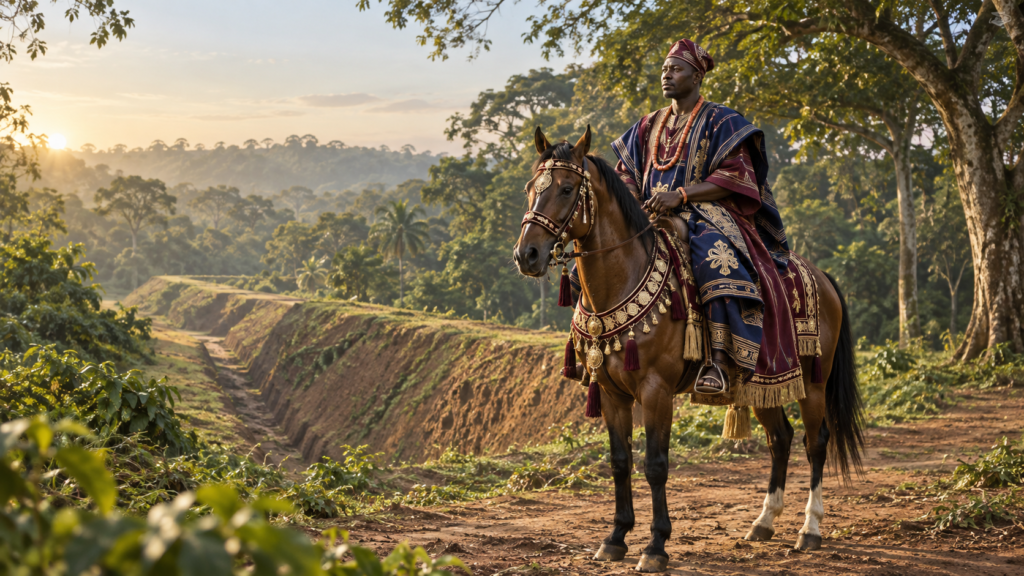

Some of the most important evidence of Ijebu power does not sit inside a palace or behind museum glass. It runs through the forest.
Around Ijebu-Ode lies an enormous system of ditch and embankment known as Sungbo’s Eredo. UNESCO’s tentative-list description records an earthwork roughly 150 kilometres long and reaching about 15 metres in depth in places. Trees and roads now cut across sections of it, yet the scale still asks a startling question: what kind of society could organise the people, time and authority needed to reshape a landscape on that level?
The answer leads into the history of the Ijebu Kingdom—one of the most commercially strategic and culturally influential Yoruba states in what is now southwestern Nigeria.
Its story is not only about an ancient boundary. It is about the throne of the Awujale, merchant networks that connected the interior to the coast, systems of political and community organisation, resistance to British expansion, and a culture that still returns home every year in the colour, horses and pageantry of Ojude Oba.
The kingdom changed. Its identity did not disappear.
Who are the Ijebu people?
The Ijebu are a Yoruba people whose historic homeland, Ijebuland, is centred on Ijebu-Ode and extends through a number of towns and communities in present-day southwestern Nigeria.
“The Ijebu” should not be imagined as one town wearing one identity. Historically, Ijebuland contained distinct geographical and political divisions, each with its own leadership and local traditions. What connected them was a wider political and cultural order in which the Awujale, seated at Ijebu-Ode, stood as the titular head of the kingdom.
That balance between a central throne and strong local institutions matters. It helps explain how Ijebuland could act as a kingdom while preserving the identities and interests of its constituent communities.
It also reminds us that Nigerian history is rarely as simple as a list of kings. Power lived in palaces, councils, associations, markets, age groups, ritual institutions and the relationships between them.
Where did the Ijebu Kingdom come from?
There is no single origin story accepted by every Ijebu community or historian.
Oral traditions connect the formation of the kingdom to figures including Olu-Iwa and Obanta, and different accounts describe migrations and relationships with other Yoruba centres in different ways. Some traditions emphasise connections to Ile-Ife. Others preserve alternative routes and ancestries.
The honest way to tell this history is to keep two truths together.
First, oral traditions are not decorative myths to be discarded. They preserve how communities understand legitimacy, kinship, sacred authority and belonging. Second, oral traditions are not always literal timelines. They can change as political relationships change, and different communities may preserve competing memories of the same past.
What historical research supports more clearly is that the Ijebu developed a durable kingdom with Ijebu-Ode as its political centre, the Awujale as its leading royal institution, and a network of communities tied together through political, commercial, military and ritual relationships.
The civilisation is real even where the beginnings remain debated.
The Awujale and the political organisation of Ijebuland
The Awujale of Ijebuland is the paramount royal title associated with Ijebu-Ode and the wider kingdom. The throne represents continuity, but the political history behind it was never simply absolute rule from the palace.
Ijebu government involved titled chiefs, local rulers and associations that helped organise administration, commerce, justice and communal life. Historical scholarship describes the Pampa society, for example, as an institution that coordinated commercial, communal and military activity in parts of Ijebuland. Other accounts discuss the Osugbo and additional bodies that formed part of the wider political order.
The details differed across communities and periods. The larger lesson is that authority was distributed through institutions. The kingdom depended on relationships: between the capital and surrounding divisions, between the throne and titled leaders, and between political power and the commercial life that sustained it.
That is one reason Ijebu history survived political shocks. A civilisation built through multiple institutions is harder to erase than one held together by a palace alone.
The Ijebu story is not only the story of a throne. It is the story of the systems—royal, commercial and communal—that made the throne meaningful.
Sungbo’s Eredo: the earthwork that reveals a kingdom’s scale
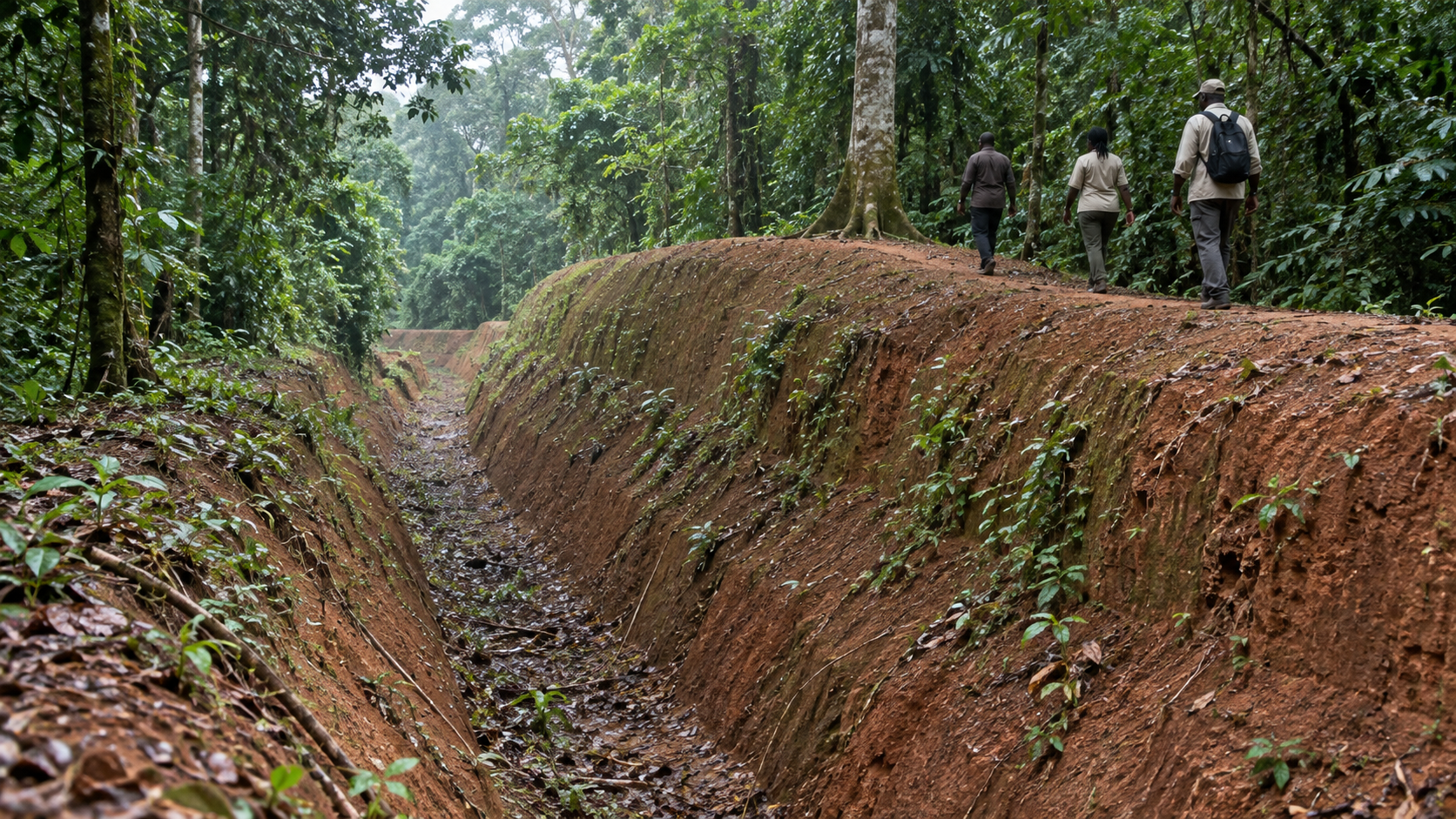
Sungbo’s Eredo is one of the most compelling physical traces of Ijebu political organisation.
Read the deeper archaeological story: explore how Sungbo’s Eredo was built, dated and remembered.
The monument is made of a long ditch with an accompanying embankment. Rather than a stone wall in the popular imagination, it is an engineered earthwork that used the landscape itself to mark and control space. UNESCO’s tentative-list record describes the Ijebu-Ode earthwork as approximately 150 kilometres long and about 15 metres deep in places.
Researchers continue to debate its chronology, precise route and full purpose. It may have served several functions at once: defining territory, controlling movement, protecting settlements and expressing the authority of the society capable of building it.
Local oral tradition also links the monument to Bilikisu Sungbo, a powerful female figure sometimes connected in popular memory to the Queen of Sheba. Archaeology does not establish that biblical identification as historical fact. But the tradition is important in its own right because it shows how communities gave memory, personality and sacred meaning to the landscape.
The safest conclusion is also the most impressive one. Whatever single story people attach to the Eredo, the earthwork required large-scale planning and labour. It contradicts the old colonial fiction that the forest zones of West Africa had no complex urban or political history before European rule.
Sungbo’s Eredo is not a curiosity beside Ijebu history. It is material evidence that the history was built at scale.
Explore the living story: Enter the ÌJÈBÚ ALÁRÉ Heritage Mode and unlock the free digital archive.
How trade made Ijebu powerful
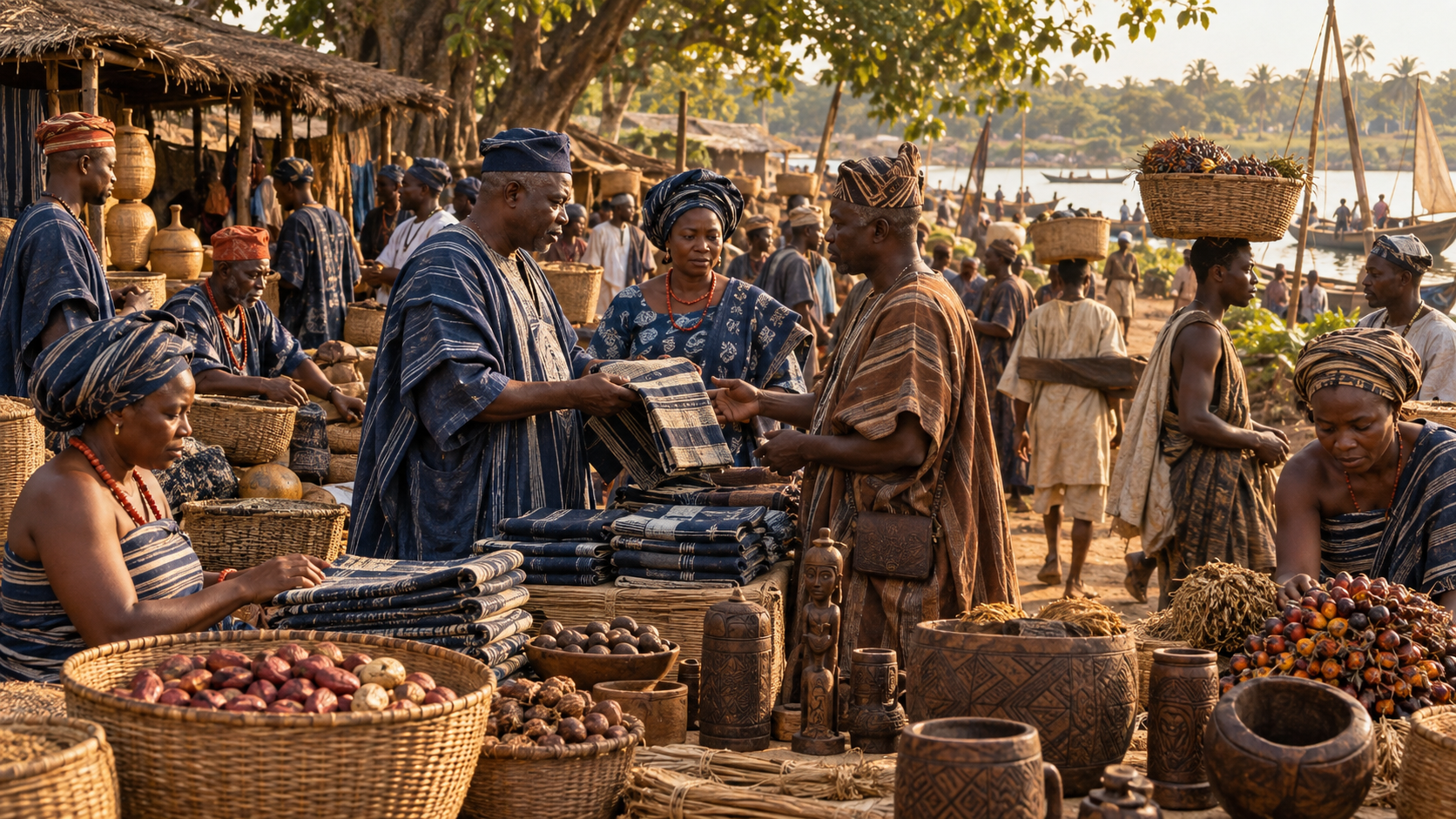
Geography placed Ijebuland between inland Yoruba centres and the lagoons and routes leading toward the Atlantic coast. That position could be dangerous, but it could also be immensely valuable.
Ijebu merchants became intermediaries in the movement of goods between the interior and coastal markets. Trade was not merely individual buying and selling. It depended on market knowledge, controlled routes, relationships, credit, negotiation and the political power to determine who could move through a territory and on what terms.
This commercial history helps explain the long association between Ijebu identity and enterprise. University of Ibadan scholar E. O. Akeredolu-Ale observed that Ijebu entrepreneurs became especially prominent among the Yoruba commercial groups that connected expatriate firms at the coast with markets in the hinterland.
That reputation did not appear from nowhere in the twentieth century. It grew from older habits of mobility, brokerage, association and trust.
Yet admiration should not become stereotype. No people are naturally “born traders,” and Ijebu society has never been one profession or personality. Commercial success came from historical circumstances and institutions: strategic location, social networks, accumulated knowledge and the ability to adapt when the political economy changed.
The 1892 Anglo-Ijebu conflict
By the late nineteenth century, the British colony of Lagos wanted freer access to markets and trade routes in the Yoruba interior. Ijebu control over movement between the coast and hinterland stood in the way of that ambition.
The resulting Anglo-Ijebu conflict of 1892 is sometimes described only as the opening of a trade road. That language hides the power behind the demand. This was a colonial military campaign against an African kingdom that had its own laws, interests and control of its territory.
British forces defeated the Ijebu and entered Ijebu-Ode. The defeat weakened the kingdom’s independence and accelerated the imposition of colonial rule. It also altered regional commerce: routes and markets increasingly operated within a political system controlled from Lagos and, later, the wider colonial state.
But 1892 was not the end of Ijebu history.
Royal and community institutions adjusted to the new order. Traders worked within new markets. Ijebu people expanded their commercial presence in Lagos and elsewhere. Cultural identity continued through families, titles, associations, festivals and the authority of memory.
The kingdom lost sovereignty. The people did not lose the ability to reorganise.
Why Ijebu enterprise endured after conquest
The most interesting part of a civilisation is often what it does after the moment history books call its “fall.”
Ijebu commercial networks did not depend on one road or one ruler. They were social as well as geographical. Knowledge moved through families and apprenticeships. Trust travelled through hometown associations and personal relationships. New transport systems and colonial markets changed the environment, but Ijebu merchants were able to adapt old commercial skills to new opportunities.
This is why the language of enterprise remains so powerful in modern descriptions of Ijebu identity. It refers to more than wealth. It suggests discipline, negotiation, reputation, community and the ability to turn connection into opportunity.
Those qualities are celebrated most visibly today not in a ledger, but in a festival.
Ojude Oba: when the kingdom gathers in front of the palace
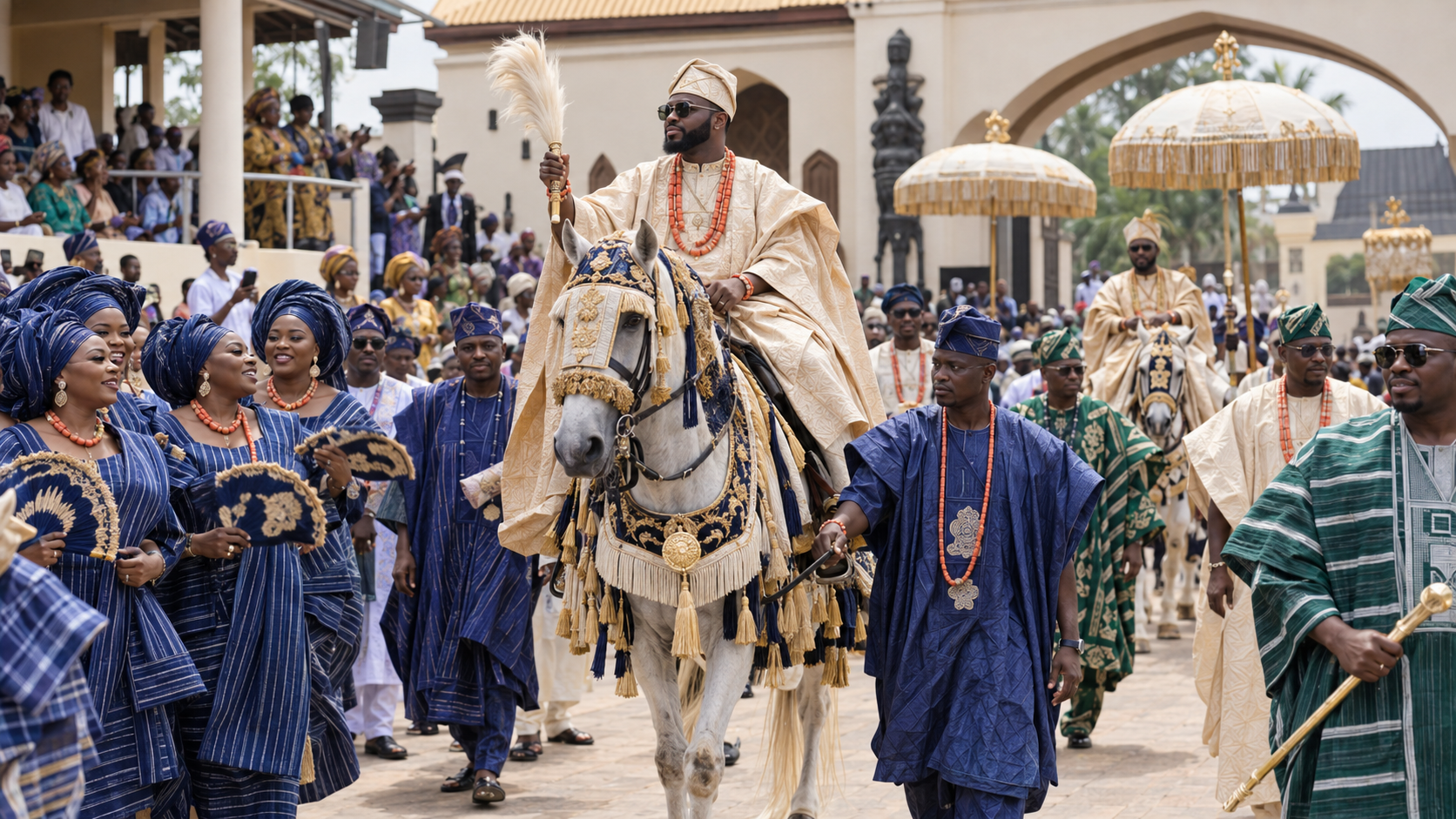
Ojude Oba means the king’s forecourt. The festival is held in Ijebu-Ode on the third day after Eid al-Kabir and brings Ijebu communities home to honour the Awujale.
The official festival account traces its development to Muslim members of the community who gathered to thank the monarch for allowing them to practise their religion. Over time, the observance grew into a much wider celebration of Ijebu identity and peaceful coexistence.
Its most recognisable features carry older institutions into a modern public spectacle:
- Regberegbe, the age-grade groups, appear in coordinated clothing and compete through style, organisation and community contribution.
- Balogun families and horse riders recall the military titles and traditions of Ijebuland.
- Music, drums, praise poetry and dance turn the palace forecourt into a performance of collective memory.
- Families and visitors return from across Nigeria and the diaspora, renewing their relationship with home.
The clothing matters because it is not merely decoration. Dress communicates group, status, creativity, continuity and belonging. A fabric chosen for one year’s procession can become part of a family’s visual archive.
Ojude Oba therefore does something history books cannot. It makes an old political relationship visible in the present. The people stand before the throne, but they also stand before one another, saying: we are still here, and this is how we choose to be seen.
What ÌJÈBÚ ALÁRÉ represents today
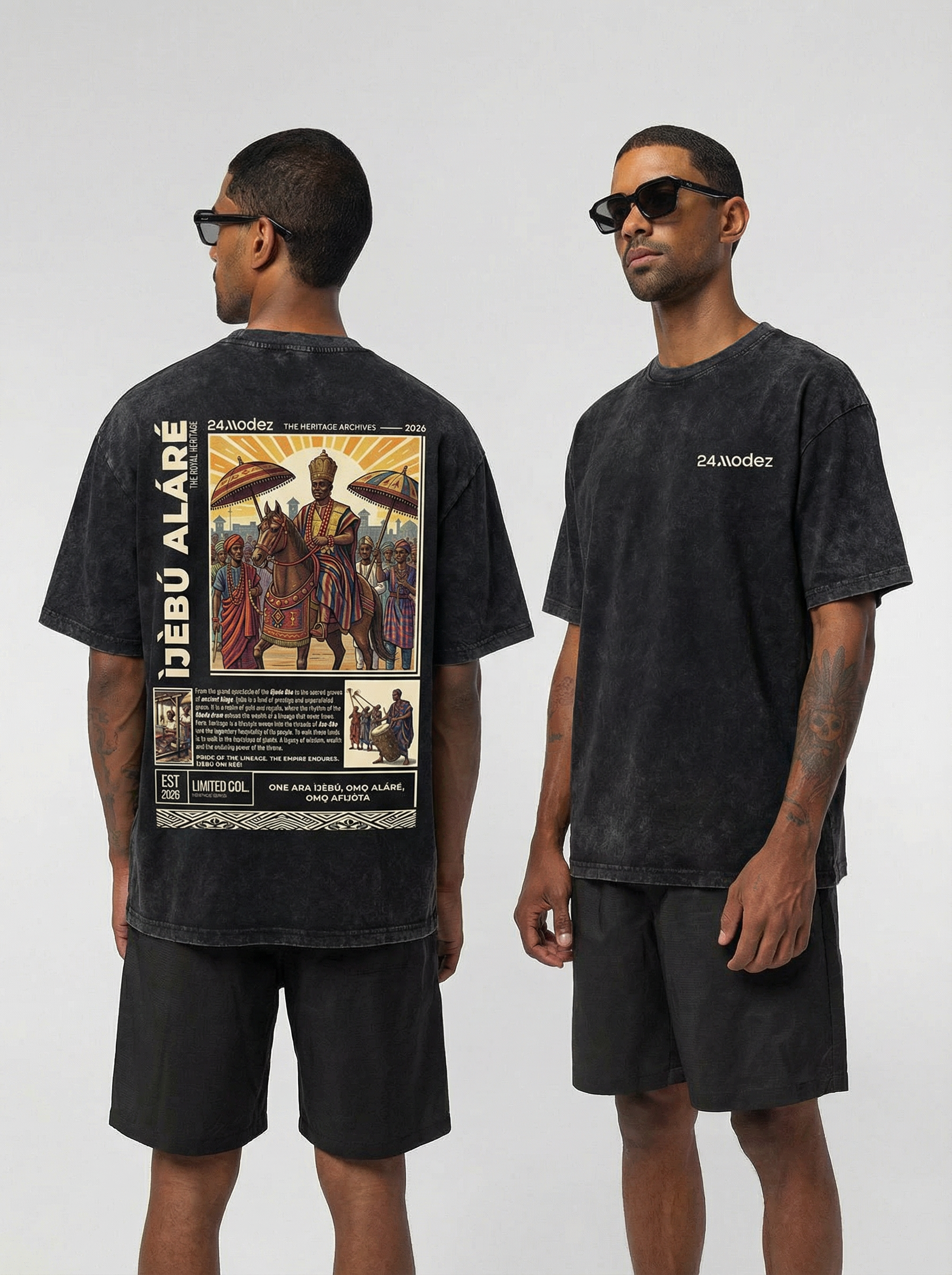
24Modez uses ÌJÈBÚ ALÁRÉ as a language of prestige, enterprise and cultural pride. The phrase belongs to a modern wearable archive, but the ideas behind it come from a much older history.
The prestige is not simply luxury. It comes from institutions that endured.
The enterprise is not a joke about money. It comes from generations of commercial intelligence and adaptation.
The pride is not nostalgia. It is the decision to carry a story forward—in a festival, a family name, a photograph, a piece of cloth or something worn on an ordinary day far from home.
That is what heritage can do when it is alive. It does not ask us to live in the past. It gives the present a deeper vocabulary.
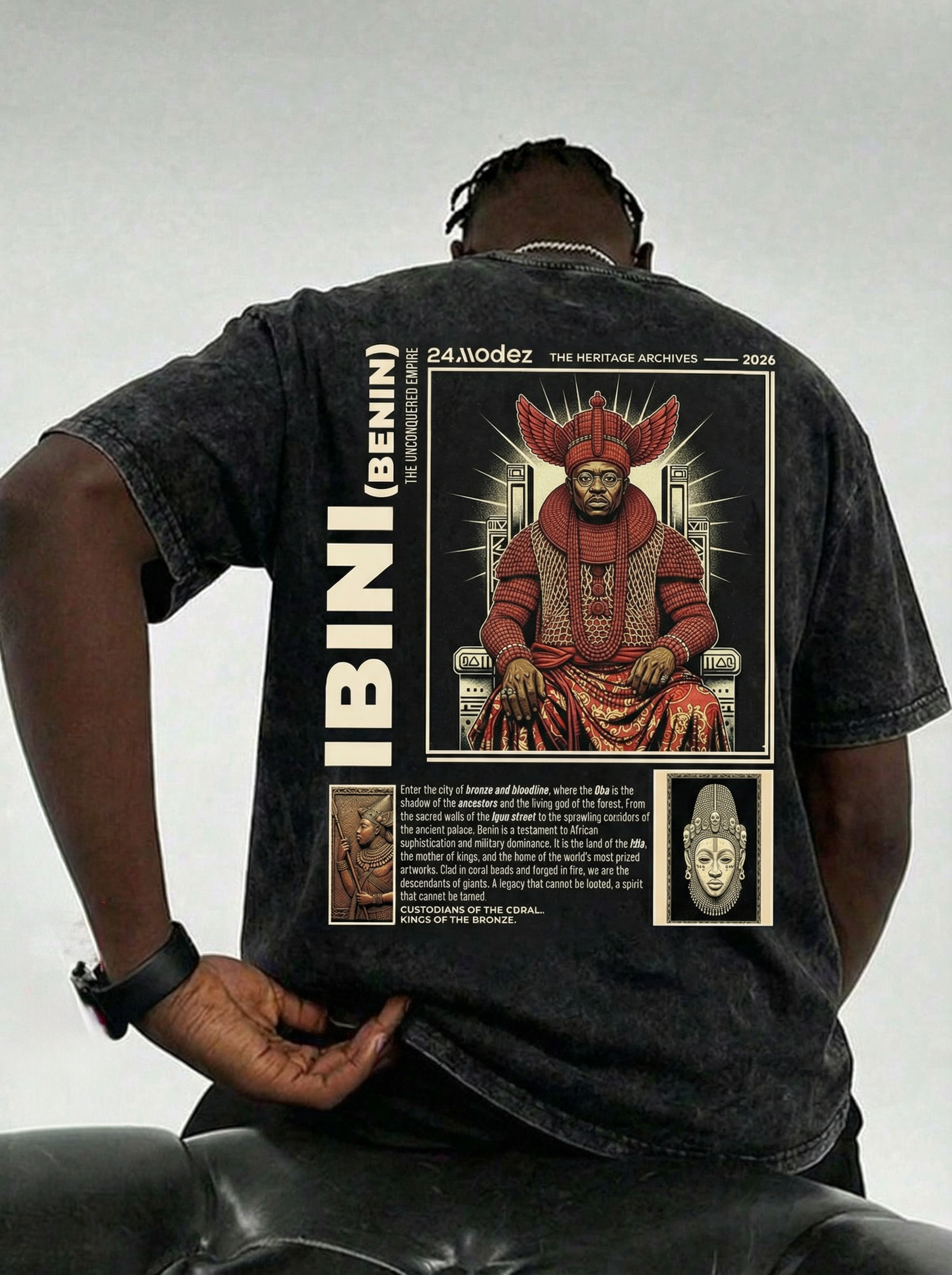
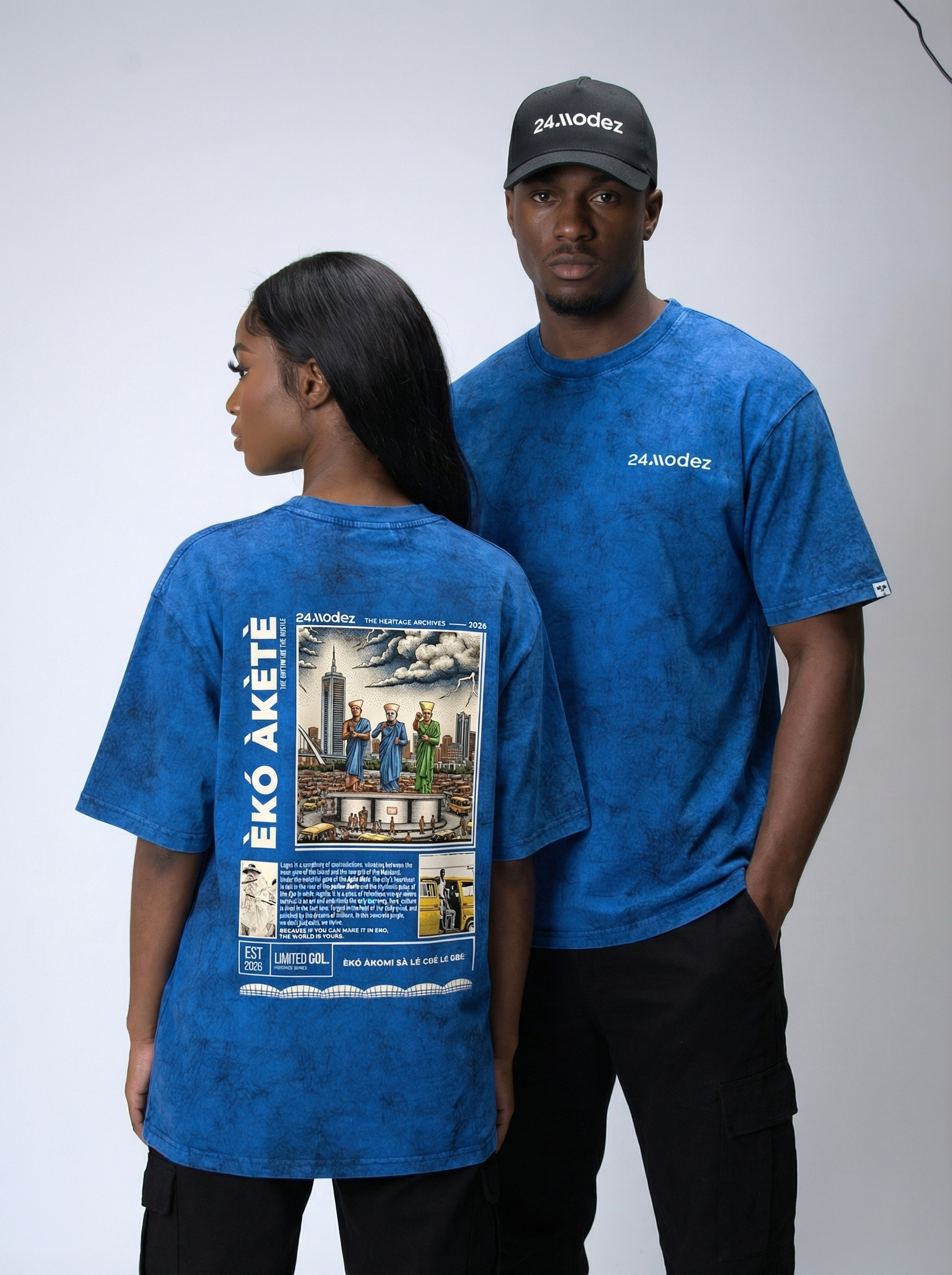
Wear the story: View the ÌJÈBÚ ALÁRÉ Heritage T-shirt, a premium made-to-order piece inspired by Ijebu identity.
Ijebu Kingdom timeline
Early state formation Communities in Ijebuland develop shared political and cultural institutions. Oral traditions connect the kingdom’s formation to figures including Olu-Iwa and Obanta, although the details differ by source.
Precolonial consolidation Ijebu-Ode becomes the seat of the Awujale and the leading centre of a kingdom composed of multiple divisions and communities.
Growth of regional trade Ijebu merchants and political authorities use the kingdom’s position between the interior and coastal routes to build influence over commerce.
Nineteenth century Trade with and around Lagos grows, while disputes intensify over control of routes between the coast and the Yoruba hinterland.
1892 British forces invade and defeat the Ijebu Kingdom, opening the way for deeper colonial control.
Twentieth century to the present Ijebu royal, commercial and community institutions adapt. Ojude Oba grows into a major public celebration of identity, homecoming and cultural continuity.
Frequently asked questions about Ijebu history
Where was the Ijebu Kingdom located?
The historic kingdom was in southwestern Nigeria, centred on Ijebu-Ode and made up of several communities and divisions across Ijebuland. Its location connected inland Yoruba regions with lagoon and coastal trade routes.
Who is the Awujale?
The Awujale is the paramount royal title of Ijebuland, with the palace at Ijebu-Ode. Historically, the throne sat within a wider political system that also involved titled chiefs, local rulers and community institutions.
What is Sungbo’s Eredo?
Sungbo’s Eredo is a massive ditch-and-embankment earthwork around Ijebu-Ode. UNESCO’s tentative-list description records it at roughly 150 kilometres in length and about 15 metres deep in places. Its exact chronology and functions remain subjects of research.
Was Sungbo’s Eredo built by the Queen of Sheba?
Local tradition associates the monument with Bilikisu Sungbo, who is sometimes identified in popular memory with the Queen of Sheba. Archaeological evidence does not establish that biblical connection as historical fact. It is best understood as an important oral tradition rather than a settled conclusion.
Why were the Ijebu known for trade?
Ijebuland occupied a strategic position between inland markets and the coast. Ijebu political and merchant networks helped control and organise movement along those routes, and Ijebu entrepreneurs later became prominent in the expanding Lagos economy.
What happened in Ijebu in 1892?
British colonial forces invaded and defeated the Ijebu Kingdom during a conflict over political authority and access to trade routes. The campaign reduced Ijebu independence and helped expand British control into the Yoruba interior.
What is Ojude Oba?
Ojude Oba is an annual Ijebu festival held in Ijebu-Ode on the third day after Eid al-Kabir. Age-grade groups, horse-riding Balogun families and other community members gather before the Awujale in a celebration of identity, style, loyalty and homecoming.
The deepest histories survive because people keep giving them form.
The Ijebu Kingdom survives in the authority of the Awujale, in the forest line of Sungbo’s Eredo, in the commercial networks that carried families into new cities, and in the annual return to the palace forecourt at Ojude Oba.
It also survives in the everyday decision to remember.
Explore the full ÌJÈBÚ ALÁRÉ Heritage Mode and download the free archive, or wear the legacy with the ÌJÈBÚ ALÁRÉ Heritage T-shirt.