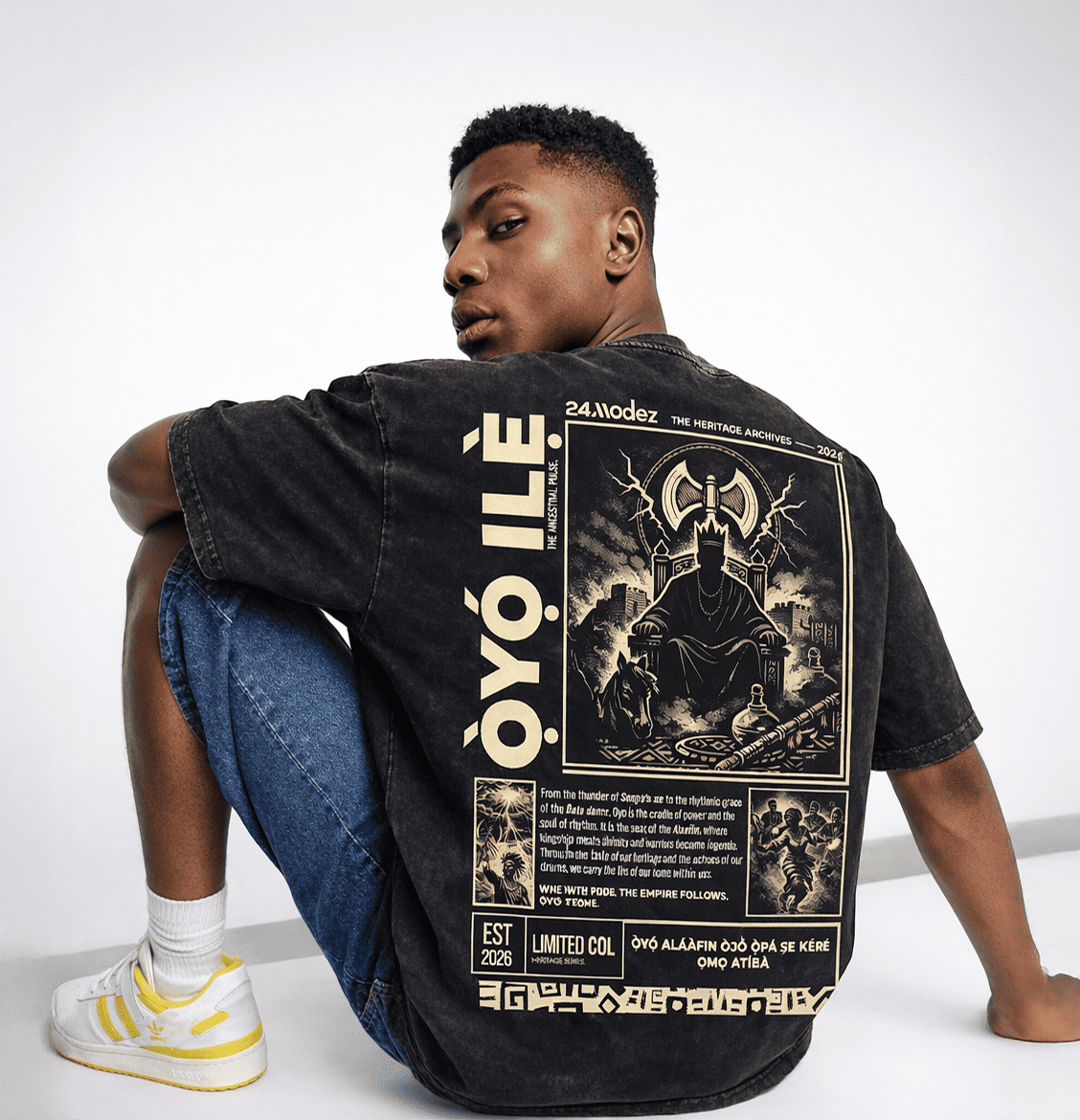



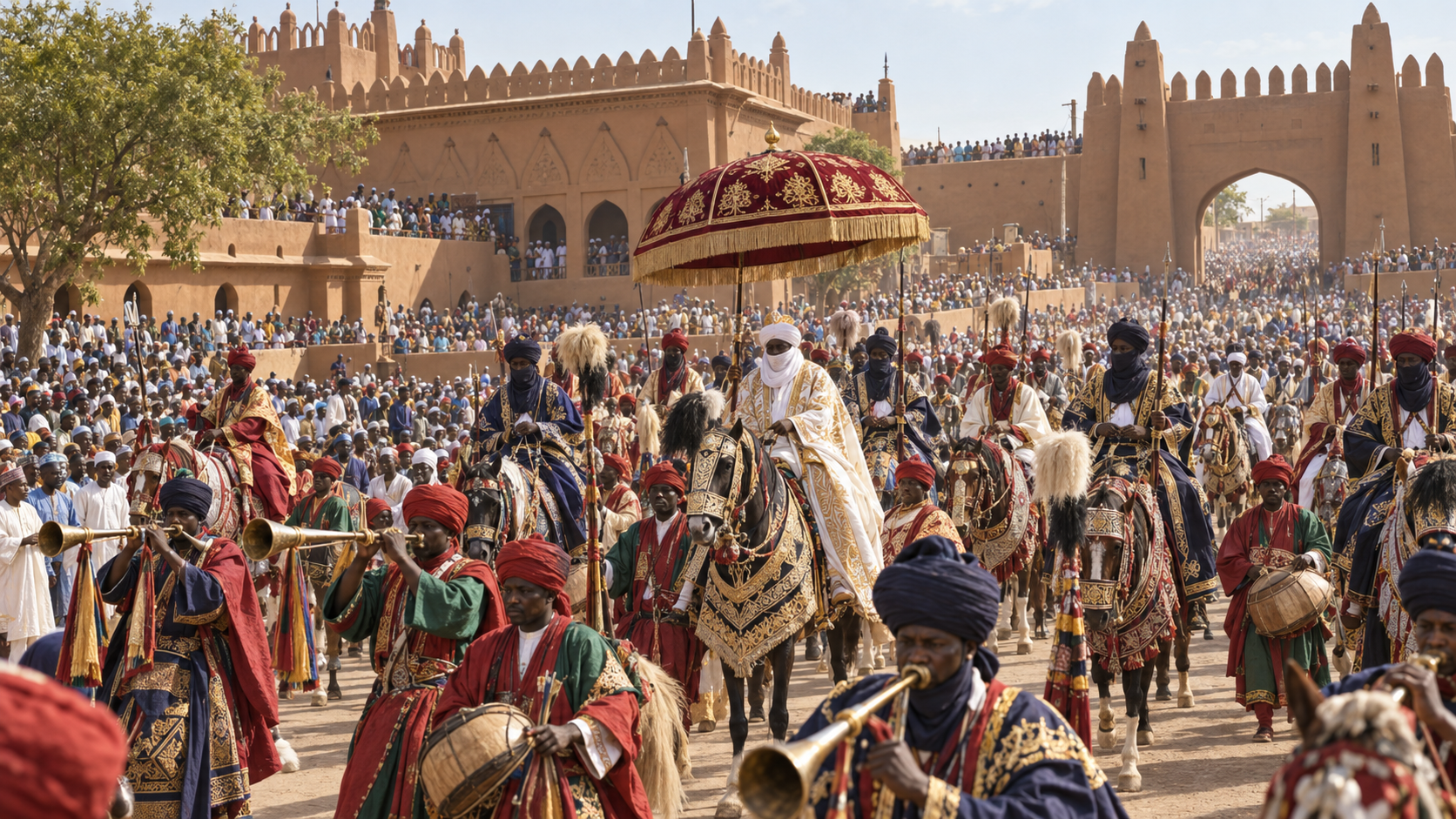
Before the procession appears, Kano hears it coming. Long kakaki trumpets answer the drums. Hooves strike the earth. Sunlight catches gold embroidery, polished leather and the bright cloth covering hundreds of horses. Then the royal party enters the road and an old city becomes a moving theatre of memory.
The Kano Durbar is often described as a colourful horse festival. That is true, but it is incomplete. Durbar is also a public language of rank, service, faith, craftsmanship and belonging. Its riders carry family histories. Its routes connect palace, neighbourhood and government. Its clothing and horse regalia preserve the work of embroiderers, leatherworkers, weavers, dyers and metalworkers. And its most dramatic moments make sense only when we understand the society behind the spectacle.
This guide explores Kano Durbar history, the Sallah processions, the famous Jahi cavalry salute and the people whose knowledge keeps the tradition alive. It also separates two ideas that are often mixed together: Kano’s deep local traditions of royal horsemanship, and the later use of the word “durbar” during British colonial rule.
What is the Kano Durbar?
The Kano Durbar is a cycle of royal processions held around the Muslim festivals of Eid al-Fitr and Eid al-Adha, commonly called Sallah in Nigeria. The Emir appears with palace officials, titleholders, guards, musicians and large groups of horsemen. Different processions move along different routes and fulfil different ceremonial purposes, but together they renew the relationship between the palace and the people of Kano.
In 2024, UNESCO inscribed the Durbar in Kano on the Representative List of the Intangible Cultural Heritage of Humanity. UNESCO describes a vast event involving thousands of people on horseback and on foot, with processions beginning and ending at palace gates, accompanied by gun salutes, music, special costumes and formal homage. The recognition is significant because it treats Durbar not as a static monument but as living knowledge carried by communities.
Is the Kano Durbar ancient or colonial?
The most accurate answer is: its foundations are older than colonial rule, while its modern name and some of its public staging were shaped during the colonial period.
Kano had a royal court, mounted warriors, palace offices, tribute, processions and Sallah ceremonies long before the British conquest of the city in 1903. Horses were central to power across Hausaland and the wider Sahel. Kano’s rulers used equestrian display to make authority visible, while titled households maintained mounted followers and distinctive insignia. The palace complex associated with the reign of Muhammadu Rumfa in the fifteenth century became the ceremonial centre of this political world.
The word durbar, however, comes through Persian and South Asian court vocabulary and was popularised in British imperial usage. Colonial officials used it for large assemblies of rulers, cavalry and subjects. In Northern Nigeria, British administrations encouraged grand mounted displays for visiting officials and major state occasions. Over time, the label “Durbar” became attached to ceremonies whose local ingredients—Sallah riding, palace homage, mounted titleholders, music and neighbourhood routes—had deeper Hausa roots.
That layered history matters. Saying the Kano Durbar was simply “invented by the British” erases older Kano institutions. Calling every part of its present form unchanged since the distant past ignores how living traditions adapt. Durbar is powerful precisely because Kano communities have continually reworked older practices while preserving their social meaning.
Why horses became symbols of power in Kano
For centuries, Kano sat within networks linking the savannah, the Sahara and the cities of West Africa. Its markets drew cloth, leather, grain, livestock, salt and other goods. Political authority depended on the ability to protect routes, command territory and communicate across distance. In that environment, a trained horse was far more than transport.
- Military value: cavalry gave states mobility, reach and shock power.
- Political rank: the number and quality of horses a titled household maintained could signal its standing.
- Economic strength: feeding, training and decorating horses required land, labour and specialist skill.
- Public service: mounted retainers represented offices and communities in the Emirate’s political order.
Durbar transforms this history into ceremony. A horse covered in embroidered cloth and hand-worked leather is not merely beautiful. It displays the rider’s office, the work of artisans and the capacity of a community to appear before the Emir with discipline and dignity.
The four major Kano Durbar processions
Kano’s official Emirate tradition identifies four principal processions. Exact schedules and routes can vary, so visitors should always confirm current arrangements, but each procession carries a recognisable purpose.
1. Hawan Sallah
Hawan Sallah is the Sallah ride. The Emir and his entourage travel from the palace in a formal procession connected to Eid prayers and the public celebration that follows. Titleholders and mounted groups assemble in elaborate regalia, and the route becomes a broad civic stage.
2. Hawan Daushe
Hawan Daushe is one of the most visually famous rides. Oral histories connect its name to Daushe, a loyal palace figure remembered from the reign of Muhammadu Rumfa. The procession includes homage connected with the senior royal household and traditionally moves towards the residence of the Mai Babban Daki, often explained as the Queen Mother’s palace. It shows how personal memory, palace hierarchy and public ceremony can become inseparable.
3. Hawan Nassarawa
During Hawan Nassarawa, the royal procession historically connects the Emir’s palace with Nassarawa and the seat of government. The journey includes remembrance, formal greetings and public statements. It is perhaps the clearest example of Durbar functioning as a bridge between inherited Emirate authority and the institutions of the modern state.
4. Hawan Dorayi
Hawan Dorayi extends the ceremonial geography beyond the palace centre. Like the other rides, it allows communities along the route to encounter the royal party and take part in the public life of Sallah. Durbar is not confined behind palace walls; it moves through Kano.
The Jahi: Kano Durbar’s unforgettable cavalry salute
The moment most likely to stop a first-time viewer is the Jahi. Groups of horsemen accelerate across the ceremonial ground towards the Emir, then pull up sharply and raise a salute. The manoeuvre compresses speed, obedience and horsemanship into a few seconds. It looks spontaneous, but it depends on long practice, trust between rider and horse, and careful organisation.
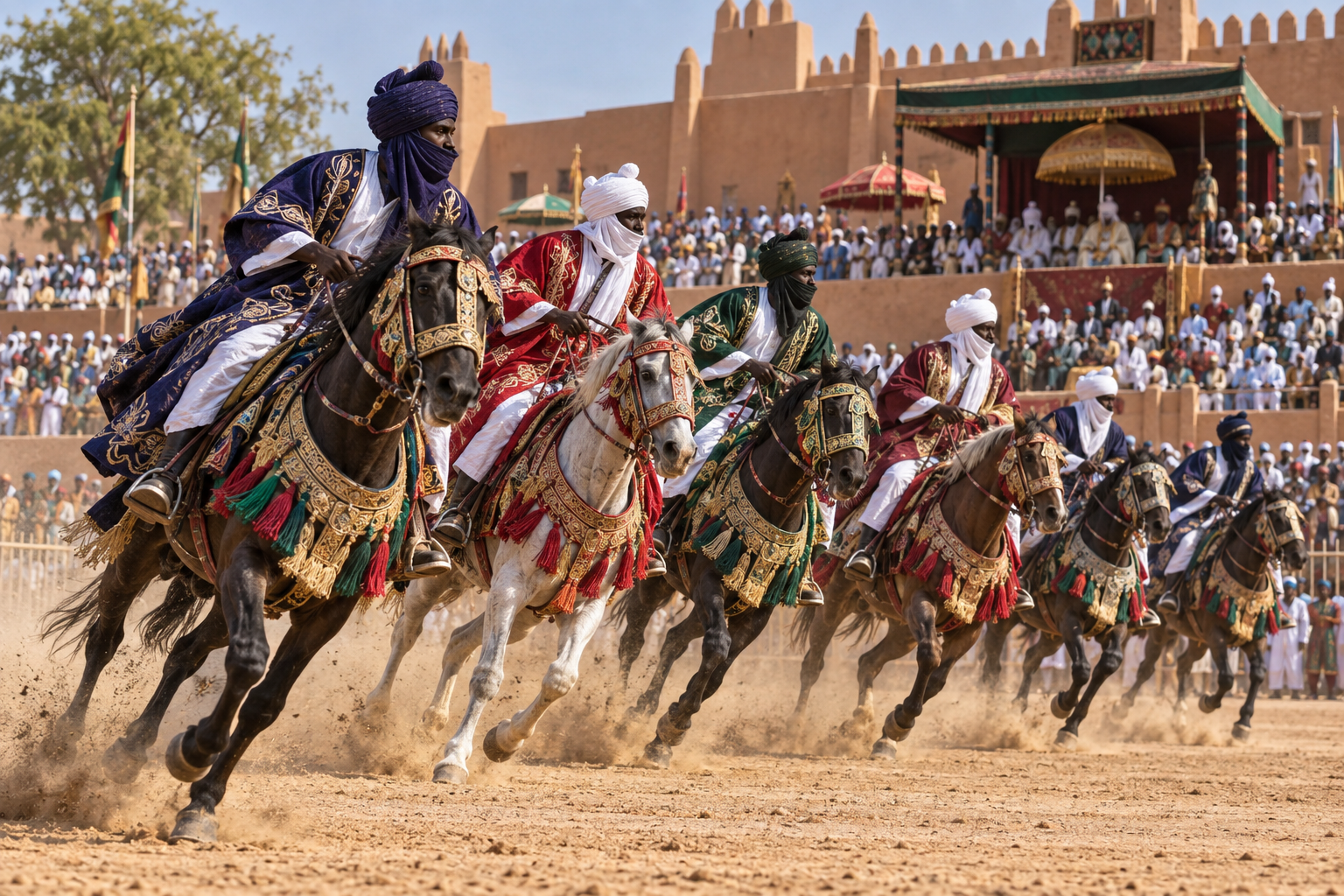
Historically, the Jahi echoed the readiness of mounted followers and the loyalty of titled groups. Today it remains both a salute and an aesthetic climax. The crowd sees courage, training and controlled force—not a mock battle, but a disciplined performance of service.
How to read the clothing, music and regalia
Durbar communicates before anyone speaks. Colour, fabric, sound and movement identify offices and announce arrival. The visual richness is not random decoration.
- Embroidered robes and turbans create volume and dignity while distinguishing individuals and groups.
- Horse coverings and bridles combine woven cloth, leather, tassels and metal fittings into moving insignia.
- Kakaki trumpets send long notes over the crowd, announcing royal presence across distance.
- Drums organise rhythm, attention and procession.
- The ceremonial parasol marks the Emir’s position even in a crowd of thousands.
- Gun salutes formally signal stages in the processions; they are ceremonial, not combat.
Seen together, these elements turn the city into a legible social map. Residents familiar with the tradition can recognise the approach of important groups through sound, dress and arrangement. Durbar therefore works like a public archive: it stores knowledge in bodies, routes, objects and repeated actions.
The artisans who make the spectacle possible
No Durbar horse emerges fully dressed from a shop window. Behind the procession are leatherworkers cutting and tooling bridles; embroiderers building raised patterns stitch by stitch; weavers and dyers preparing cloth; metalworkers shaping fittings; grooms caring for horses; and musicians learning demanding repertoires.
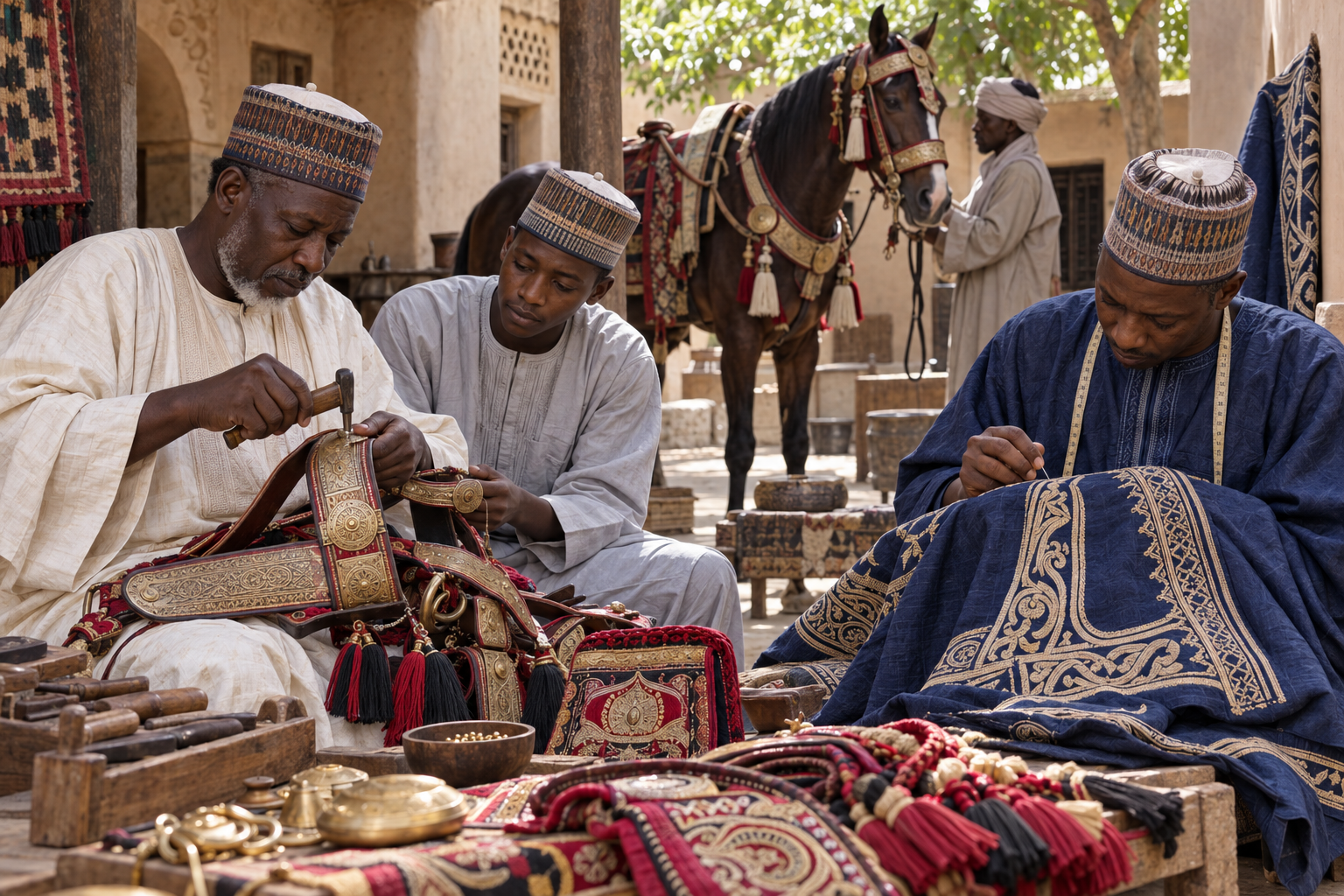
This is one reason UNESCO’s intangible-heritage recognition is important. Protecting the festival cannot mean protecting only the final parade. It must also support the networks of knowledge that make the parade possible. When an apprentice learns how leather should bend around a moving horse, or how an embroidered pattern must sit on a rider, heritage moves from one generation to the next.
Durbar as a relationship between palace and city
The palace is the ceremonial heart of the event, but the city completes it. Processions pass through neighbourhoods. Families watch from roadsides, doorways and balconies. Groups present themselves, offer greetings and receive recognition. Homage expresses loyalty, yet the Emir’s movement through the city also makes leadership visible and answerable to a public.
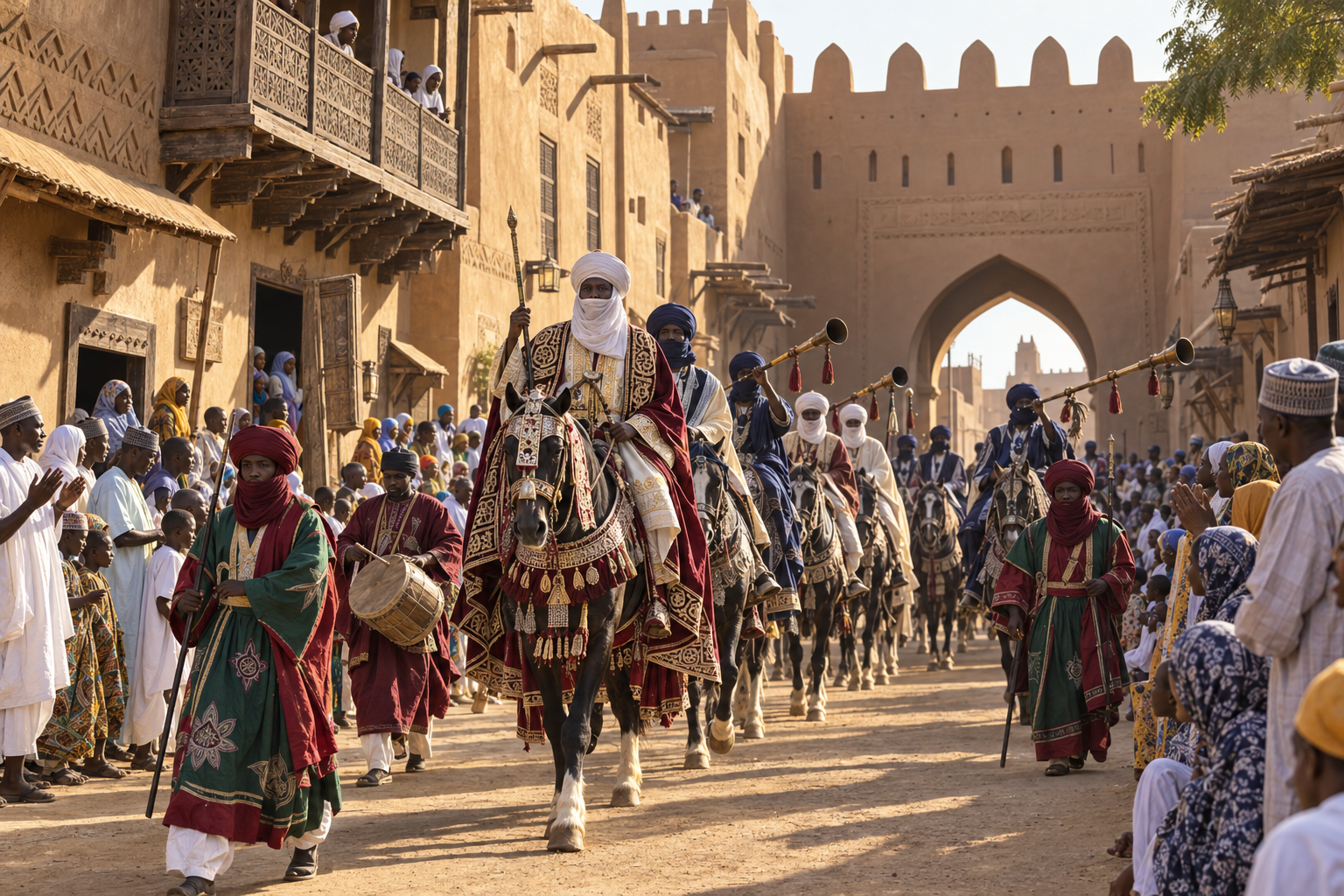
This shared ownership explains why Durbar remains meaningful even as Kano changes. The festival can attract visitors and international attention, but its deepest audience is local. It renews relationships among palace offices, titled families, craftspeople, neighbourhoods and worshippers at a sacred point in the Muslim calendar.
What UNESCO recognition means—and what it does not mean
UNESCO inscription in 2024 gave the Kano Durbar greater international visibility. It can support documentation, education and safeguarding, and it recognises the community knowledge embedded in the event. But UNESCO did not invent the tradition, own it or freeze it into one “correct” form.
Living heritage changes. Routes may respond to urban growth and security conditions. Costumes develop. New generations learn old skills in new circumstances. Safeguarding should therefore help communities transmit meaning, not turn the city into a museum set.
How to experience Kano Durbar respectfully
If you plan to attend, remember that Durbar is part of Sallah and the civic life of Kano—not simply a tourist performance. Programmes can change, especially where crowd safety and public security are concerned.
- Check current official announcements. Confirm dates, routes and access through Kano State and recognised local security information close to the festival.
- Arrive early and follow barriers. Horses need space, particularly during the Jahi. Never step into a riding line for a photograph.
- Dress with respect for Sallah. Light, modest clothing works well in Kano’s heat.
- Ask before close portraits. A wide public procession and an individual’s face are not the same photographic situation.
- Use local knowledge. A responsible guide can explain offices, routes and signals that a visitor might otherwise miss.
- Support the culture around the event. Buy from local makers and learn about Kano’s markets, architecture and craft traditions beyond the parade.
Kano beyond the Durbar
Durbar opens a door onto a much larger history. Kano grew around Dala Hill and became one of the great Hausa cities. Kurmi Market, associated with the fifteenth-century reign of Muhammadu Rumfa, connected the city to long-distance commerce. The royal palace, city walls, gates, markets, mosques, dyeing traditions and scholarship all belong to the same urban story.
That broader perspective also places Kano beside other sophisticated African political traditions. The cavalry and checks on authority in the history of the Oyo Empire, for example, took a different form, but both histories challenge the lazy idea that precolonial African states lacked complex institutions. Across the continent, power was organised, debated, displayed and remembered in locally specific ways.
Frequently asked questions about Kano Durbar
When is the Kano Durbar held?
It is traditionally held during the Sallah periods of Eid al-Fitr and Eid al-Adha. Because the Islamic calendar is lunar, the Gregorian dates move each year. Individual processions and routes may also change, so check official local announcements before travelling.
What does “Durbar” mean?
The word has Persian roots and came into British imperial vocabulary through South Asia, where it referred to a ruler’s court or formal assembly. In Kano, the name now refers to a locally rooted cycle of Sallah processions, royal horsemanship, music and public homage.
What is the Jahi in Kano Durbar?
The Jahi is a cavalry salute in which groups of horsemen charge towards the Emir’s position, halt under control and offer homage. It demonstrates riding skill, discipline and loyalty.
Is Kano Durbar a religious festival?
It takes place during Muslim Eid celebrations and is closely tied to Sallah, but it also has royal, civic, historical and artistic dimensions. It brings faith, palace tradition and city life together.
Is the Kano Durbar on UNESCO’s heritage list?
Yes. UNESCO inscribed Durbar in Kano on the Representative List of the Intangible Cultural Heritage of Humanity in 2024.
Wear Kano’s story
A heritage design should do more than borrow an attractive symbol. It should invite a question: What history am I carrying? The Kano Heritage T-shirt is part of the 24Modez Heritage Archive—a modern piece connected to the city’s strength, craft, trade and ceremonial presence.
The Durbar endures because it is more than a performance. It is Kano remembering itself in public—through the sound of trumpets, the patience of artisans, the discipline of riders and the movement of a city around its history.